
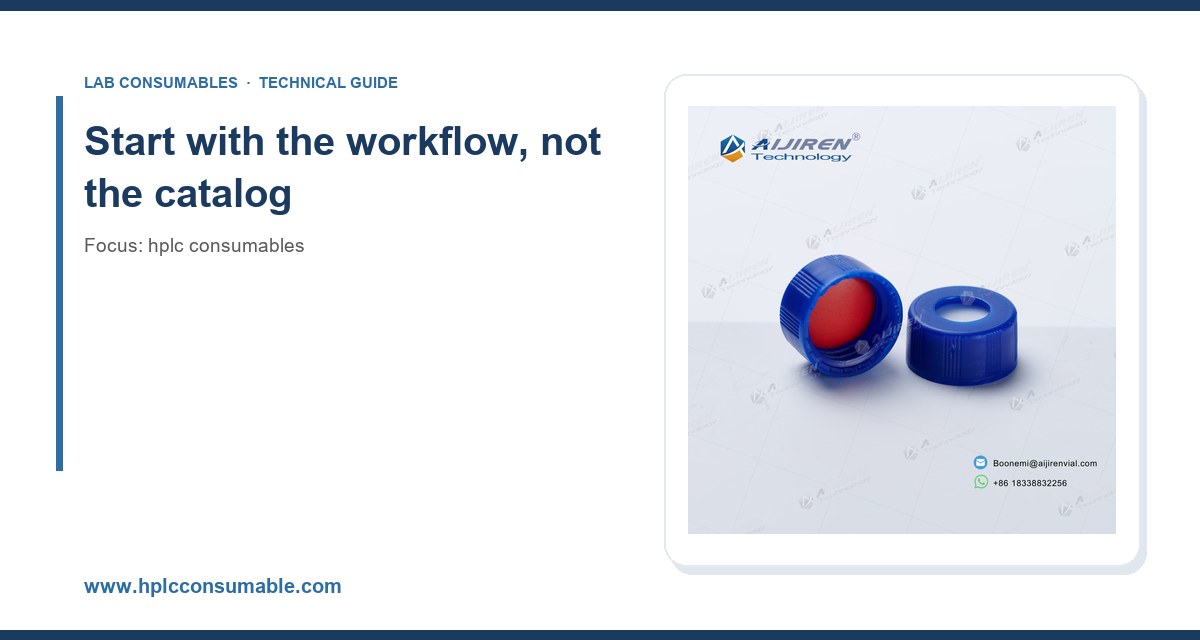
I once watched a lab burn through three months of column budget in six weeks because someone bought 2 mL autosampler vials with 8 mm closures for a workflow that needed 12 x 32 mm vials with 9 mm screw caps. The vials fit the tray. The caps threaded. What failed was everything downstream: the autosampler gripper dropped one in twenty, the septa coring rate went through the roof, and the HPLC method started showing ghost peaks at 210 nm. Nobody had thought to check the closure dimension against the autosampler spec before the PO went out. That story is why I write buying guides.
This article is for the people who actually place the orders and the people who run the instruments. Procurement managers, lab managers, analytical chemists doing method development. I will cover what to specify, what to avoid, and what numbers matter when you are choosing HPLC consumables for a workflow that has to run 200 injections a week without babysitting.
Most bad consumable decisions happen because the buyer starts with a supplier catalog and works backward. The right order is the reverse. Map the workflow first: sample volume per injection, injection count per day, mobile phase composition and pH, column temperature, detector type, and the regulatory framework the lab answers to. Every one of those parameters narrows the consumable list before you open a single product page.
What to document before you buy anything
- Injection volume and sample loop size. A 10 µL loop with partial-loop injection needs different vial fill volumes than a 100 µL full-loop setup. Underfilling a vial below the needle depth causes air in the loop and RSD% above 2%.
- Mobile phase pH range. Below pH 2 or above pH 8, you are outside the safe zone for standard silica-based C18. This drives column selection more than anything else.
- Maximum column backpressure. UHPLC systems at 1000+ bar need sub-2 µm particles and columns rated for the pressure. A 400 bar HPLC column on a UHPLC system is a burst fitting waiting to happen.
- Detector wavelength. UV below 220 nm is unforgiving of extractables from septa, caps, and vial glass. This is where cheap consumables show up as baseline noise.
- Regulatory context. USP <621> for chromatography system suitability, EPA SW-846 for environmental methods, 21 CFR Part 11 for data integrity. These determine documentation and traceability requirements, not just the physical part.
If you cannot fill in the table above for a given method, you are not ready to buy consumables. You are guessing. I have seen labs buy $30k of columns based on a guess and then re-buy three months later.
Columns: the highest-stakes purchase
Columns are 60 to 80 percent of your consumable spend and 90 percent of your method performance. Get this right first.
Particle size and pressure rating
For conventional HPLC at 400 bar systems, 5 µm particles in 4.6 x 150 mm or 4.6 x 250 mm columns are the workhorses. For UHPLC at 600 to 1300 bar, you want sub-2 µm particles in 2.1 x 50 mm or 2.1 x 100 mm. The 2.1 mm ID reduces solvent consumption by roughly 75 percent versus 4.6 mm at the same flow velocity, which matters if you are running acetonitrile at $80 a liter.
The pressure rating on the column hardware is not the same as the particle pressure rating. Check both. A column rated for 600 bar on a 1300 bar system will fail at the end fitting, usually on a Friday afternoon.
Bonded phase selection
C18 is the default for a reason. It handles most reversed-phase separations, has the widest method literature base, and is the cheapest per column. Deviate only when you have a specific reason:
- C8 for faster equilibration and less retention of very hydrophobic analytes.
- Phenyl or phenyl-hexyl for aromatic compounds and pi-pi interactions that C18 misses.
- Mixed-mode (C18 with cation exchange) for basic drugs at low pH where pure C18 gives poor peak shape.
- HILIC for polar analytes that do not retain on C18 (sugars, amino acids, small polar metabolites).
- PFP (pentafluorophenyl) for positional isomers and halogenated compounds.
If you are buying from Agilent, their chromatography consumables and columns catalog is a reasonable reference point for phase selection charts. Restek’s technical resources are also worth bookmarking for application notes and phase comparison data. Both vendors publish retention indices and selectivity data you can use to predict whether a phase swap will solve your separation problem.
Column dimensions and method transfer
If you are transferring a method between column dimensions, use the standard scaling equations. Flow rate scales with the square of the diameter ratio, and injection volume scales with the cube of the diameter ratio if you keep the same bed length. A method on 4.6 x 250 mm at 1.0 mL/min translates to 2.1 x 100 mm at roughly 0.2 mL/min with a 4.5x smaller injection volume. Get this wrong and your peaks will either overload or disappear below the detection limit.
Guard columns and inline filters
I will say this plainly: run a guard column. A $40 guard cartridge that you change every 200 injections protects a $600 analytical column. The math is not complicated. Inline 0.2 µm frits at the column inlet catch particulate from samples and mobile phase, and they cost less than a coffee. Replace them when backpressure climbs 10 to 15 percent above baseline.
Autosampler vials and closures: where most labs lose money
Vials and caps are cheap individually and expensive collectively. Small mistakes here compound across thousands of injections.
Vial dimensions and standards
The two dominant formats are:
- 2 mL, 12 x 32 mm with a 9 mm screw thread or crimp neck. This is the industry standard for HPLC autosamplers and the format most people mean when they say “HPLC vial.”
- 2 mL, 11 mm crimp or snap-top for older instruments and specific autosampler models.
- Microvolume vials at 300 to 600 µL for limited-sample applications, often in 12 x 32 mm footprints with inserts.
The GPI (Glass Packaging Institute) thread finish standards define the 9 mm screw thread and the 13-425 and 15-425 sizes you will see on larger containers. When you buy vials and caps from different suppliers, confirm both conform to the same GPI finish. A 9 mm cap from one vendor on a 9 mm vial from another usually works, but “usually” is not a specification.
Glass grade matters more than you think
Use Type I borosilicate glass (USP Type I) for any method with UV detection below 240 nm or any trace analysis at ppb levels. Type I has the lowest extractables and the lowest alkali leaching. Type III soda-lime glass is fine for pH-neutral aqueous samples at high concentration, but I have seen it produce sodium adducts in LC-MS and baseline drift in low-wavelength UV.
Amber glass for light-sensitive analytes. Silanized (deactivated) glass for proteins, peptides, and any analyte that sticks to silanol groups. If you are running oligonucleotides or basic proteins, deactivated glass is not optional.
Septa: the most under-specified part in the workflow
Septa are the failure point most labs ignore until they see ghost peaks. Common materials and their trade-offs:
- Silicone: excellent resealability, high puncture count (often 50+), but high extractables and poor solvent resistance. Not for LC-MS.
- Silicone/PTFE sandwich: PTFE on the sample side, silicone for reseal. The default for HPLC. Good balance of cost and performance. Puncture count typically 20 to 30 before coring becomes a problem.
- PTFE/silicone pre-slit: adds a slit for needle guidance, reduces coring, but the slit is an evaporation path. Not for long autosampler runs or volatile analytes.
- Bonded or molded PTFE: lowest extractables, best for LC-MS and trace analysis, but lower puncture count and higher cost.
For a 96-hour autosampler run, evaporation through the septum is a real problem. A 2 mL vial with a standard silicone/PTFE septum can lose 5 to 10 percent of a volatile solvent over that window, which concentrates your sample and shifts your calibration. Pre-slit septa lose more. If you need to run overnight or over a weekend, use a bonded septum and consider a vial with a smaller headspace.
Caps and torque
Screw caps should be tightened to a consistent torque. For 9 mm screw caps, 0.4 to 0.6 N·m (roughly 3.5 to 5.3 in-lb) is the working range. Under-torque and the cap backs off during the run, causing evaporation and needle misalignment. Over-torque and you crush the septum, which cores it on first puncture and creates a permanent leak path. Hand-tightening with a proper capping tool is more consistent than fingers. If you are capping 500 vials a day, buy the torque-limited capping tool. It pays for itself in reduced reruns.
For a reliable source of matched vials and closures, look at the OEM vial options and the vial closures catalog. Buying vials and caps from the same supplier removes the dimensional mismatch risk entirely.
Inserts and residual volume
If you are working with 50 µL of sample, a 2 mL vial with a 250 µL insert is not the answer. The insert has a residual volume of 5 to 20 µL depending on geometry, and the autosampler needle has to reach within 1 mm of the bottom. A conical insert with a pulled-glass point gets residual volume down to 2 to 5 µL. For anything below 100 µL total sample, use a dedicated microvolume vial rather than an insert. The recovery and the RSD% will be better.
Mobile phase and solvent handling consumables
The consumables between the solvent bottle and the column head get overlooked, and they cause more baseline problems than any other category.
Solvent inlet filters and frits
Use 10 µm stainless steel or glass frits on the solvent inlet line. Stainless is durable but can shed particles if it corrodes; glass is inert and cheap. Replace when you see visible buildup or when the pump struggles to prime. A clogged inlet frit causes cavitation, which shows up as erratic retention times and pump noise.
Degassing
If you are running at flow rates above 1 mL/min with mixed solvents, you need active degassing (helium sparge or inline vacuum). Dissolved oxygen causes baseline noise at low UV wavelengths and can react with your analyte. Inline degasser membranes have a service life of 2 to 5 years; replace them on schedule, not on failure.
Mobile phase filtration
Filter mobile phase through 0.2 µm membrane before it hits the system. Nylon for aqueous, PTFE for organic, and never mix the two without checking compatibility. Particulate in the mobile phase is the leading cause of check valve failure and column inlet frit clogging. A $0.50 filter is cheaper than a $300 check valve.
Fittings, tubing, and the small parts that fail
Most leaks and dead-volume problems trace back to fittings. This is where I see the most improvisation and the most problems.
Fitting standards
Know which fitting standard your instrument uses. The major ones:
- 1/16 inch is the standard for analytical HPLC tubing and fittings.
- 10-32 coned is the classic HPLC fitting, still common on older systems.
- Flat-bottom (PEEK) fittings are standard on modern UHPLC systems for high-pressure connections.
- UHP (ultra-high pressure) fittings rated for 1300+ bar on UHPLC.
Mixing fitting types is the fastest way to introduce dead volume, which shows up as peak broadening and split peaks. If you cannot identify the fitting on your instrument, look it up in the service manual before you buy replacements.
Tubing
Use 0.005 inch ID PEEK or stainless tubing for connections between the pump and injector, and between the column and detector. Larger ID adds dead volume. Smaller ID adds backpressure. For UHPLC, 0.003 inch ID is common. Cut tubing square, deburr, and do not overtighten. A crushed ferrule is a permanent leak until you replace the fitting.
Detector and flow cell consumables
Flow cells are not consumables in the traditional sense, but the lamps and windows are. UV lamps have a rated life of 2000 to 4000 hours; track hours in the instrument log and replace on schedule. A lamp past its rated life causes baseline drift and reduced sensitivity that looks like a column problem but is not. Deuterium lamps for UV detectors and tungsten lamps for visible detectors. Keep spares on hand; a failed lamp mid-run is a lost day.
For RI and fluorescence detectors, the flow cell windows and seals are replaceable. Keep a spare seal kit. For LC-MS, the ESI needle and the capillary are consumables, and their condition drives sensitivity drift across a run.
Selection checklist with numbers
Here is the decision table I use when specifying a consumable set for a new method. Print it, fill it in, and hand it to procurement.
- Column: 4.6 x 150 mm, 5 µm C18 for conventional HPLC at ≤400 bar; 2.1 x 100 mm, 1.8 µm C18 for UHPLC at ≤1000 bar; pH range 2 to 8 for standard silica, 1 to 12 for hybrid particles.
- Guard column: same phase as analytical, replaced every 200 injections or when backpressure rises 10 to 15 percent.
- Inline filter: 0.2 µm, replaced every 100 to 200 injections.
- Vial: 2 mL, 12 x 32 mm, USP Type I borosilicate, 9 mm screw thread, deactivated if analytes are basic or proteinaceous.
- Cap: 9 mm screw, silicone/PTFE septum for standard UV; bonded PTFE for LC-MS or <220 nm detection.
- Torque: 0.4 to 0.6 N·m on 9 mm caps.
- Septum puncture count: replace cap after 20 to 30 punctures (silicone/PTFE), 10 to 15 (bonded PTFE).
- Mobile phase filter: 0.2 µm, nylon for aqueous, PTFE for organic.
- Inlet frit: 10 µm, replaced when pump priming becomes difficult or on a 6-month schedule.
- UV lamp: replace at 2000 hours (deuterium) or per manufacturer spec, whichever is sooner.
- Tubing: 1/16 inch OD, 0.005 inch ID PEEK for HPLC; 0.003 inch ID for UHPLC.
- Fittings: match the instrument standard (10-32 coned, flat-bottom PEEK, or UHP); never mix.
Where to buy and how to qualify a supplier
Price is the last criterion, not the first. The first is dimensional and material conformance. Ask for certificates of analysis on glass (USP Type), septa (extractables data), and columns (lot-specific performance data). A supplier who cannot provide a CoA for the glass type is not a supplier you want for regulated work.
For general HPLC consumables, the Hplc Consumables catalog covers the standard range of columns, vials, filters, and fittings. For broader sourcing across instrument brands, the Chromatography Supplier network is a useful cross-reference for compatibility. Thermo Fisher’s chromatography and sample handling pages are a good reference for matching consumables to specific instrument models. For environmental methods, the EPA SW-846 test methods define the consumable specifications that methods like 8270 and 8081 require.
Qualification steps I use
- Order a small trial lot (one box of vials, one column, one pack of caps) before committing to a standing order.
- Run a system suitability test per USP <621>: tailing factor ≤2.0, resolution ≥2.0 between critical pairs, RSD% ≤2.0 across six injections.
- Compare baseline noise at 210 nm against your current supplier’s product. Anything above 0.5 mAU difference is a red flag.
- Check septum coring visually after 20 punctures. Visible fragments on the needle or in the vial mean the septum is failing.
- Confirm the cap torque with a torque tester on ten random caps. If the range is wider than 0.2 N·m, the capping process is out of control.
Troubleshooting checklist
When a method goes sideways, work through this list in order. Nine times out of ten the problem is in the first four items.
- Ghost peaks in blank injections: septum extractables, vial glass leachables, or mobile phase contamination. Swap to bonded PTFE septa and Type I glass, and run a fresh mobile phase.
- Retention time drift: column equilibration, mobile phase evaporation, or pump check valve. Check the solvent level, re-equilibrate with 10 column volumes, and test the check valve.
- Rising backpressure: inlet frit, guard column, or column inlet. Replace in that order.
- Peak broadening or splitting: dead volume from a mismatched fitting, a partially clogged frit, or a void at the column inlet. Check fittings first.
- Poor RSD% on injection: vial underfill, needle depth, or a coring septum. Check fill volume against needle depth and inspect the septum.
- Baseline noise at low UV: dissolved oxygen, lamp aging, or mobile phase contamination. Degas, check lamp hours, and filter fresh solvent.
- Loss of sensitivity in LC-MS: ESI needle condition, capillary contamination, or high-extractable septa. Replace the needle and switch to bonded septa.
Takeaway
Buying HPLC consumables is a specification exercise, not a shopping exercise. Document the workflow parameters first (pH, pressure, wavelength, injection count), then match columns, vials, septa, and fittings to those parameters with the numbers in hand: 9 mm closures torqued to 0.4 to 0.6 N·m, USP Type I glass, 0.2 µm filtration, guard columns changed every 200 injections, and septum puncture counts tracked rather than assumed. Qualify every new supplier with a system suitability run before you commit to a standing order. The labs that get this right spend less per year and spend far less time rerunning failed batches.
References & further reading
Related resources from our lab consumables network:
- Hplc Consumables at hplcconsumable.com
- Chromatography Supplier at chromatographysupplier.com
- Oem Vial at oemsamplevials.com
- Vial Closures at vialclosures.com
External references and standards: