
I have been on both sides of this table: buying HPLC consumables for a contract lab, then selling them as a distributor. The fastest way to lose money is not a bad column. It is a purchasing file that looks tidy on paper and hides a 40% price spread between two suppliers quoting the “same” vial, plus a 10,000-piece MOQ you will never burn through before the septa go soft. This is the procurement framework I use now, with the numbers I actually check.
Before you negotiate anything, split the category. Suppliers price these lines on completely different cost models, and lumping them into one RFQ guarantees you get apples-to-oranges quotes.
- Columns and guard cartridges. Hardware plus packing cost. Priced per unit, sensitive to particle size (1.8, 2.7, 3.5, 5 µm), dimensions (2.1 × 50 mm vs 4.6 × 250 mm), and whether the particle is fully porous or superficially porous. Guard cartridges are the consumable inside the consumable, and they carry the highest margin.
- Sample vials and closures. Glass moulding plus cap assembly. Priced per thousand. The cost driver is dimensional tolerance, not material volume.
- Septa and liners. Elastomer formulation and lamination. Priced per thousand. This is where cheap suppliers quietly substitute silicone for silicone/PTFE and you find out at autosampler puncture 60.
- Filters and syringe tips. Membrane (PTFE, PVDF, nylon, RC) plus housing. Priced per hundred. Pore size 0.22 µm vs 0.45 µm, diameter 13 mm vs 33 mm.
- Solvents and mobile phase additives (HPLC grade). Priced per 2.5 L or 4 L bottle, freight-heavy, hazmat-restricted.
- Fittings, tubing, and ferrules. Priced per pack. Small spend, high downtime impact. A wrong ferrule stops a run as fast as a blocked column.
If you buy across all six lines, you are not running one procurement exercise. You are running six, and the negotiation levers differ for each. The full catalogue structure at Hplc Consumables is a useful reference for how these lines group into spend categories.
Pricing: what actually moves the number
Unit price on a quote is the last thing to look at. First, work out the cost per injection or cost per sample. That is the only number that survives contact with a budget review.
Cost per injection, not cost per column
A 4.6 × 250 mm, 5 µm C18 column at $420 that survives 1,500 injections costs $0.28 per injection. A 2.1 × 50 mm, 1.8 µm UHPLC column at $560 that survives 2,200 injections costs $0.25 per injection. The cheaper column is the more expensive one per sample. I have watched procurement teams chase a 12% list-price discount and miss a 30% difference in injections per column. Run the arithmetic on your own method before you shortlist.
Guard cartridges change the maths. A guard at $18 replaced every 150 injections adds $0.12 per injection, but it can double the analytical column life. On dirty matrices (plasma, soil extracts, food), the guard pays for itself. On clean standards, it is overhead. Know which method you are buying for.
Volume tiers and where they break
Most suppliers publish tier breaks at 1, 5, 10, and 25+ units for columns, and 1,000, 5,000, 10,000, and 50,000 for vials and closures. The real discount sits between the 1 and 10 unit tier (typically 15 to 25%). Above 25 units, the curve flattens and you are negotiating freight, not price. On vials, the 5,000 to 10,000 step is where a serious supplier will move 20 to 35% off the 1,000-piece rate. Ask for the break table in writing, not verbally.
Hidden cost lines that change the landed price
- Freight on glass. Vials ship heavy and fragile. A 10,000-piece order can carry $300 to $600 in freight and insurance. A supplier quoting FOB factory and one quoting DDP to your dock are not comparable.
- Hazmat surcharges. Acetonitrile and methanol carry carrier surcharges. Budget 8 to 15% on solvent lines.
- Cold-chain and desiccant. Some bonded phases and standards need temperature control. Ask whether the price includes it.
- Certificate of analysis (CoA). A CoA per lot should be free. A supplier who charges for it is telling you something about their QC.
- Currency and payment terms. A 2% early-payment discount and 60-day terms are worth more than a 3% price cut on a 30-day term. Model both.
Price benchmarks you can hold a supplier to
These are indicative 2024-2025 ranges for standard catalogue items, not custom phases. Use them to sanity-check a quote, then adjust for your region and currency.
- Standard C18 analytical column (4.6 × 250 mm, 5 µm): $280 to $480.
- UHPLC C18 column (2.1 × 100 mm, 1.8 µm): $450 to $700.
- Guard cartridge (4 × 10 mm, 5-pack): $70 to $130.
- 2 mL clear glass vial, 12 × 32 mm, with cap and septa (per 1,000): $90 to $180.
- 9 mm screw cap with silicone/PTFE septum (per 1,000): $60 to $120.
- 0.22 µm PTFE syringe filter, 13 mm (per 100): $45 to $90.
- HPLC grade acetonitrile, 4 L: $90 to $160.
If a quote sits more than 30% below the bottom of these ranges, assume a substitution until the CoA and a sample lot prove otherwise. That is not cynicism. It is pattern recognition.
MOQ: the number that quietly kills your cash flow
Minimum order quantity is not a supplier convenience. It is a working-capital decision disguised as a line on a quote.
Typical MOQ structures by product line
- Columns: usually 1 unit, often with a price break at 5 and 10. Some manufacturers set a $500 to $1,000 order minimum across the account rather than per SKU.
- Vials and closures: 1,000 to 5,000 per SKU for catalogue stock. Custom colours, printed caps, or non-standard neck finishes push this to 10,000 to 50,000.
- Septa: 1,000 minimum, often 5,000 for a specific lamination.
- Filters: 100 to 500 per pack, with case minimums of 1,000 to 5,000.
- Solvents: case of 4 × 4 L, no exceptions on hazmat lines.
Run the shelf-life arithmetic before you accept a volume break
This is where I have seen the most damage. A 30% discount on 20,000 vials is worthless if you use 400 a week and the septa have a two-year shelf life from manufacture. Do the maths: 400 per week is roughly 20,800 per year, so a 20,000-piece order is about 11 months of stock. That is fine. A 50,000-piece order is 2.4 years of stock, and you will be scrapping the last third.
Septa are the worst offender. Silicone/PTFE laminated septa are typically good for two years from date of manufacture when stored cool and dry. Unlaminated silicone or natural rubber can degrade faster and absorb analytes. Ask for the manufacture date on the lot, not the delivery date. A supplier who cannot or will not provide it is not a long-term partner.
When a high MOQ is actually correct
High MOQ makes sense when three things are true at once: the SKU is used on a high-throughput routine method, the shelf life comfortably covers consumption, and the price break is real. If a 10,000-piece vial order cuts your cost per vial from $0.14 to $0.09 and you will burn the stock in 12 months, take it. If any of those three fails, negotiate a smaller first order with a price held for 12 months instead. Most suppliers will do this for a new account.
How to evaluate an HPLC consumables supplier
A supplier is not a price list. It is a quality system, a stock position, and a person who answers the phone at 4 p.m. on a Friday when a run is down. Score them on all three.
Technical qualification: ask for documents, not assurances
Any serious supplier can produce these on request within one business day. If they cannot, that is your answer.
- ISO 9001 certification for the supplier or manufacturer, with the certificate number and expiry date.
- Lot-specific CoA for columns (retention, asymmetry, theoretical plates, pressure) and for vials (dimensional check, hydrolytic resistance class).
- Dimensional drawings for vials and closures. You want 12 × 32 mm body, 6 mm neck OD, 9 mm thread, and a GPI 9 mm finish. Ask for the drawing, not a photo.
- Material declarations: USP Class VI or equivalent for elastomers in contact with sample, and a statement on extractables.
- Traceability: can they tell you which mould and which lot made the vials in your box?
On the instrument side, cross-check consumable compatibility against the OEM’s own documentation. Agilent’s chromatography consumables and column resources and Thermo Fisher’s chromatography and sample handling pages both publish dimensional and compatibility data you can hold a third-party supplier against. If a supplier’s drawing disagrees with the OEM spec, the supplier is wrong until proven otherwise.
Quality consistency: the tests that catch substitution
Cheap consumables rarely fail on day one. They fail on consistency. Put these checks into your incoming inspection, even if it is light-touch.
- Vial dimensional check. Sample 30 vials per lot with calipers. Body height 32.0 ± 0.5 mm, body OD 12.0 ± 0.3 mm, neck ID within ± 0.2 mm. Out-of-tolerance necks cause autosampler gripper faults and needle bends.
- Septa puncture test. Run a needle through the same septum 50 times and check for coring. A good silicone/PTFE septum should not shed visible fragments into the vial. If it does, you have a source of ghost peaks and a blocked needle.
- Cap torque check. For screw caps, target 0.8 to 1.2 N·m on a torque tester. Under-torqued caps evaporate; over-torqued caps crack the neck. Both show up as injection volume RSD above 2%.
- Column performance check. Run a standard mix on receipt. Track retention time RSD (target < 1% across 10 injections), asymmetry (target 0.9 to 1.2), and backpressure against the CoA. Keep a log per lot.
- Filter integrity. Check for membrane separation and housing cracks on a sample lot. A burst filter dumps particulate into the column.
These checks cost about an hour per lot. They have saved me more than one batch of results. Method-level references such as the U.S. EPA SW-846 test methods are useful for setting acceptance criteria on QC checks, because they spell out the performance expectations rather than leaving them to opinion.
Supply reliability: the questions that separate distributors from box-shifters
- Stock position. Ask how many units of the SKU are on the shelf today, and where. A supplier holding local stock ships in 24 to 48 hours. A drop-shipper quotes 4 to 6 weeks and calls it “lead time”.
- Lead time in writing. Get a committed lead time per line, not an average. Columns 3 to 10 days, vials 5 to 15 days, custom closures 4 to 8 weeks.
- Single-source risk. Ask which manufacturer makes each line. If every line comes from one factory and that factory has a fire, you have no supply. A good distributor carries two qualified sources per critical SKU.
- Emergency supply. Ask what happens at 5 p.m. on a Friday. The answer tells you whether they are a partner or a portal.
- Returns and replacement. A defective column should be replaced, not “investigated” for six weeks. Get the replacement policy in writing.
Commercial terms to compare side by side
Build a simple scorecard. Weight it to your operation. Here is the one I use, with the weights I give a mid-size QC lab.
- Landed price per injection or per 1,000 units (30%). Include freight, duty, and hazmat.
- Quality documentation and lot consistency (25%). CoA, drawings, incoming inspection pass rate.
- Lead time and stock position (20%). Committed days, local stock, emergency supply.
- MOQ and shelf-life fit (10%). Can you buy to consumption, not to discount?
- Technical support (10%). Can they answer a selectivity question, or only a stock question?
- Payment terms and currency (5%). 60-day terms, price holds, FX exposure.
Score each supplier out of 5 per line, multiply by weight, and rank. The winner is rarely the cheapest. It is usually the one that scores 4 or 5 on documentation and lead time and sits within 10% on price.
Vials and closures: the spec sheet that actually matters
This is the highest-volume line in most labs and the one where “equivalent” means least. Get specific.
- Dimensions. 2 mL vial, 12 × 32 mm, 9 mm screw thread, GPI 9 mm finish. Confirm the neck finish against the GPI standard, not against a competitor’s catalogue photo.
- Glass. USP Type I borosilicate for pH-sensitive or basic analytes. Type I hydrolytic resistance matters; ask for the test result.
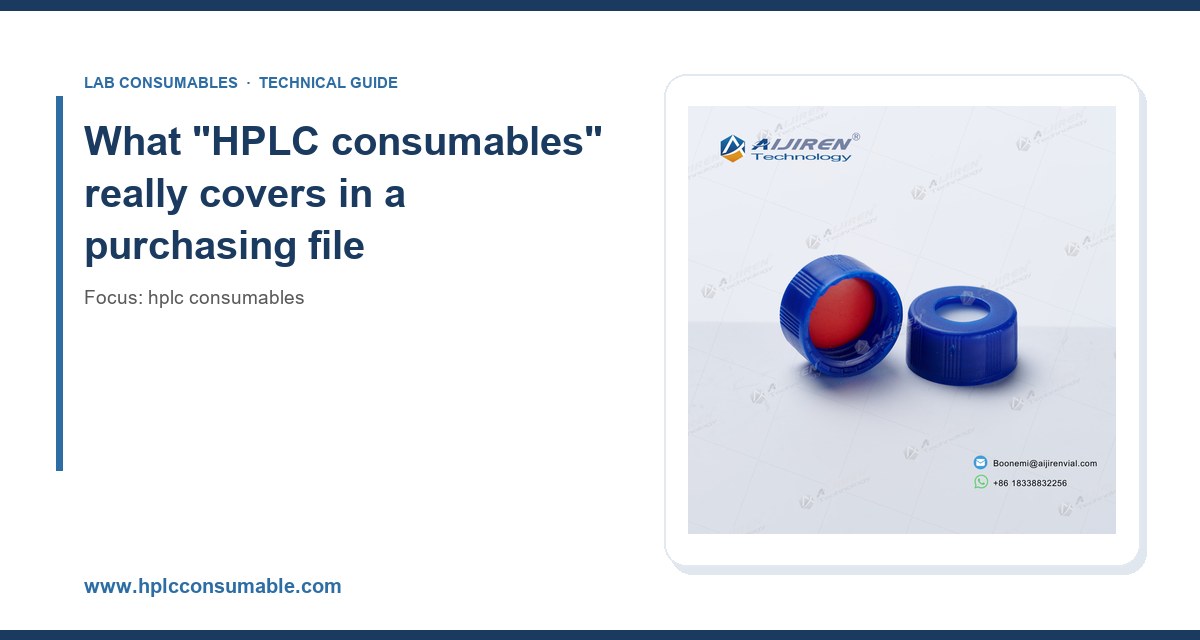
- Septa. Silicone/PTFE laminated, 1.0 mm thickness for standard 9 mm caps. PTFE faces the sample; silicone provides the seal. Unlaminated septa absorb analytes and shed coring.
- Puncture count. Specify a minimum. 50 punctures without coring is a reasonable acceptance criterion for a routine autosampler.
- Cap torque. 0.8 to 1.2 N·m. Check with a torque tester on a sample of 10 per lot.
- Autosampler compatibility. Confirm gripper and tray fit for your specific instrument. A 0.3 mm neck difference is enough to cause pick-up faults.
If you need custom colours, printed caps, or a non-standard neck, go to a specialist rather than a generalist. The OEM vial route is how you get a drawing that matches your autosampler without paying catalogue markup, and the vial closures range is where to check cap and septum combinations against your instrument. For a broader view of who supplies what, the chromatography supplier directory is a useful cross-reference before you shortlist.
Negotiation: the levers that actually work
You will not win on list price alone. You win on structure.
- Bundle the lines. A supplier will move more on vials if you also buy columns, because columns carry the margin. Ask for a basket price, not a line price.
- Commit to a 12-month volume, not a single order. A volume commitment with quarterly releases gets you the tier price without the shelf-life risk.
- Ask for a price hold. 12 months on catalogue lines, with a documented adjustment mechanism for solvents (which track commodity markets).
- Trade payment terms for price. 60-day terms are worth roughly 2% to a distributor. If you can pay in 30, ask for the 2%.
- Get the emergency-supply clause. A commitment to hold buffer stock for your critical SKUs, priced at list, is worth more than a 5% discount.
For method-specific technical questions, use the manufacturer’s own resources rather than the distributor’s sales team. Restek’s technical resources for chromatography are a good example of the depth you should expect when you ask a supplier a selectivity or stability question. If the supplier cannot point you to that kind of documentation, they are a box-shifter.
Troubleshooting checklist: when a consumable is the suspect
Before you blame the instrument, run this list. In my experience, a consumable is the root cause in roughly half of “instrument” faults.
- Ghost peaks or rising baseline. Check septa coring and vial cleanliness. Run a blank vial lot. If the peaks disappear, the septa are the source. Replace with laminated silicone/PTFE and re-test.
- Injection volume RSD above 2%. Check cap torque (target 0.8 to 1.2 N·m) and septum integrity. Under-torqued caps evaporate; cored septa leak.
- Autosampler pick-up faults. Measure vial neck ID and body height. Out-of-tolerance vials cause gripper faults. Check against the 12 × 32 mm drawing.
- Rising column backpressure. Check the guard cartridge first, then the frit, then the filter. A burst or bypassed filter dumps particulate into the column.
- Poor peak shape or tailing. Check the guard and the mobile phase. If the guard is exhausted, replace it before you touch the analytical column.
- Retention time drift. Check lot-to-lot column performance against the CoA. If retention RSD exceeds 1% across 10 injections on a new lot, the lot is suspect.
- Needle blockage. Inspect the septum for coring. A single cored septum can block a needle and stop a run.
Keep a log per lot: date received, CoA checked, incoming inspection result, first use, and any fault. That log is your evidence when you ask for a replacement, and it is your early warning when a supplier’s quality starts to slip.
Recommendation: the procurement model I would run
If I were setting up consumables procurement for a lab running 200 to 500 samples a week, this is the model I would put in place.
- Two qualified suppliers per critical line. One primary, one approved backup. Both hold current ISO 9001 and lot-specific CoAs. Both have passed an incoming inspection on a sample lot.
- Buy to consumption, not to discount. Target 3 to 6 months of stock on high-turnover lines (vials, septa, filters) and 1 to 2 units on columns, with a 12-month price hold. Never buy more than 12 months of a shelf-life-limited SKU.
- Standardise the vial and closure spec. 12 × 32 mm, 9 mm GPI finish, USP Type I glass, silicone/PTFE laminated septa, 1.0 mm, 50-puncture minimum, 0.8 to 1.2 N·m cap torque. Put it in the purchase specification and hold every supplier to the drawing.
- Run the cost-per-injection calculation on every column RFQ. Include guard consumption and expected injections. The lowest unit price is rarely the lowest cost per sample.
- Score suppliers on the weighted card. Price 30%, documentation 25%, lead time 20%, MOQ fit 10%, technical support 10%, terms 5%. Review annually.
- Keep an incoming inspection log per lot. One hour per lot. It is the cheapest insurance in the lab.
The suppliers worth keeping are the ones who send the drawing before you ask, quote a committed lead time, and answer a selectivity question with a reference rather than a price. Price gets you to the table. Documentation, stock position, and a phone that gets answered keep you there. Build the file around those three, and the 10% price spread stops being the thing that decides your year.
References & further reading
Related resources from our lab consumables network:
- Hplc Consumables at hplcconsumable.com
- Chromatography Supplier at chromatographysupplier.com
- Oem Vial at oemsamplevials.com
- Vial Closures at vialclosures.com
External references and standards: