
I still remember the first time I audited a supplier’s QC data and found that their “USP-compliant” vials were failing dimensional checks on the neck OD by 0.4 mm. That single deviation cost us three weeks of autosampler jams and a batch of 96 samples that had to be re-run. Procurement of HPLC consumables looks simple on paper: pick a part number, negotiate a price, place a PO. In practice, the difference between a smooth quarter and a lab full of rejected runs comes down to how carefully you specify, qualify, and contract with your supplier. This article is what I wish someone had handed me before I signed my first annual consumables agreement.
HPLC consumables are a strange category. Individual line items are cheap (a vial costs cents, a guard cartridge a few dollars), but the aggregate spend across a mid-size lab can easily hit six figures a year. More importantly, these parts touch every sample. A bad lot of septa can bleed siloxanes into your mobile phase and ruin a 200-injection sequence. A mis-molded ferrule can leak at 400 bar and stop a run mid-sequence overnight. The cost of a failed consumable is rarely the part itself; it is the instrument downtime, the repeat analysis, the delayed release of a batch, and the analyst hours spent chasing a ghost peak.
That asymmetry between unit price and failure cost is why I treat consumables procurement as a quality function, not just a purchasing function. You are buying a physical interface to a $60,000 instrument and to a validated method. Treat the specification accordingly.
The real cost structure of an HPLC consumable
Before you negotiate anything, understand what you are actually paying for. A list price on a vial or column is built from a handful of cost drivers, and knowing them tells you where a supplier can and cannot move.
Material and molding cost
For vials, the dominant cost is the glass itself. Type I borosilicate (USP Type I, borosilicate 33 expansion) costs more than Type II or Type III soda-lime. The difference is real: Type I has low extractables, high hydrolytic resistance, and consistent dimensions. A 2 mL autosampler vial in Type I glass with a 9 mm screw thread and a GPI 9-425 finish typically runs $0.08 to $0.18 per vial at volume, versus $0.03 to $0.06 for a soda-lime equivalent. That price gap is where a lot of “bargain” suppliers live, and it is where your method robustness quietly erodes.
Closure and septa cost
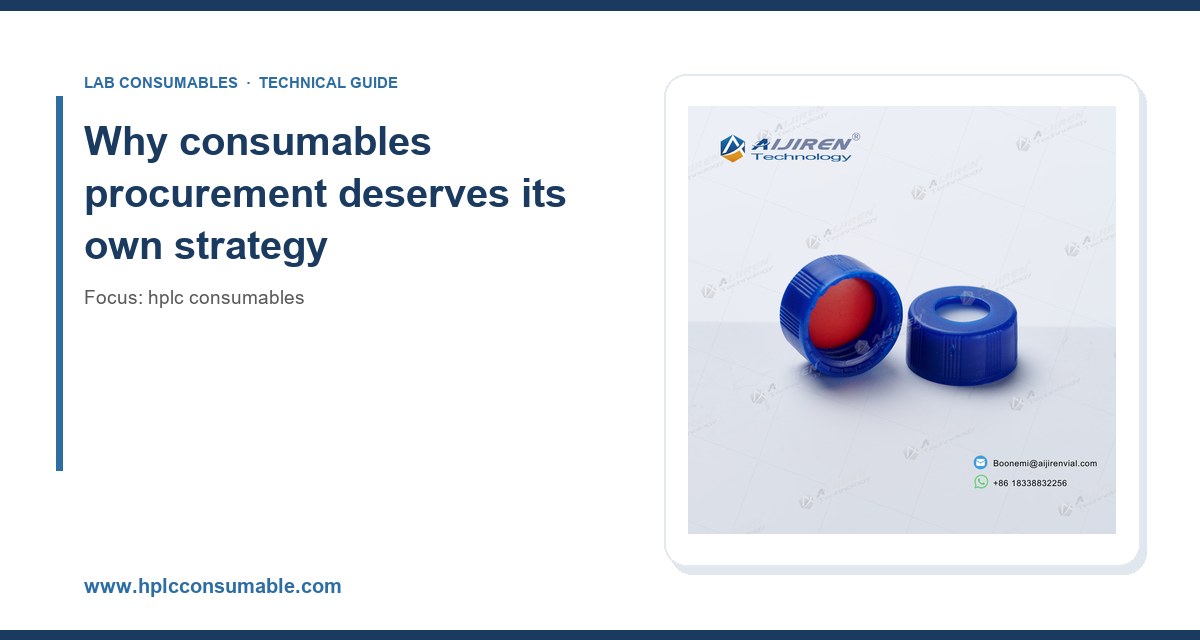
The closure is where the engineering hides. A screw cap is a shell plus a septa. The septa material drives both cost and performance: silicone, PTFE-faced silicone, natural rubber, butyl, and various laminates all behave differently under autosampler needle puncture. A good 9 mm PTFE/silicone septa rated for 50 to 100 punctures at a 23-gauge needle costs more than a single-use silicone disc rated for 10. If your autosampler is doing short sequences with fresh vials, you do not need the high-puncture septa. If you are running long sequences with re-injection, you do. Match the septa to the workflow, not to the catalog’s premium tier. You can see the closure options and their specs at vial closures.
Column and hardware cost
Analytical columns are a different cost model. A 4.6 x 150 mm, 5 µm C18 column from a major brand runs $350 to $650; a UHPLC 2.1 x 100 mm, 1.8 µm column runs $450 to $800. The packing, the frit, the end-fitting tolerances, and the batch-to-batch reproducibility are what you are buying. This is why columns are rarely a commodity purchase and why you should not treat them like vials in a bid.
Freight, packaging, and lead time
Do not ignore these. A pallet of glass vials is heavy and fragile. Freight can add 8 to 15 percent to landed cost, and a poorly packed shipment arriving with 3 percent breakage eats your savings. Ask for the packaging spec (foam-lined cartons, dividers, pallet configuration) and get it in writing. Lead time matters too: a 2-week lead time on a $200 guard cartridge order is worth more than a 5 percent discount on a 6-week lead time if it keeps a method running.
MOQ: what it really means and how to negotiate it
Minimum order quantity is the number that most often trips up first-time buyers. Suppliers set MOQ for their own reasons: mold setup time, packaging runs, and inventory carrying cost. Your job is to understand which of those levers you can pull.
Typical MOQ ranges by product type
- Autosampler vials (2 mL, 9 mm): 1,000 to 10,000 units per case, often sold in cases of 100 or 1,000. MOQ at the factory level is usually 10,000 to 50,000 for a custom color or print.
- Screw caps and septa: 1,000 to 5,000 units, with custom septa MOQ often 10,000.
- Guard cartridges: 10 to 50 packs, depending on brand.
- Analytical columns: 1 unit is normal, but volume discounts start at 5 to 10 units.
- Tubing, ferrules, fittings: 10 to 100 pieces per size.
Custom branding (your lab’s name on a cap, a specific septa laminate, a non-standard vial height) always pushes MOQ up. If you need OEM vial customization, expect to commit to a 12-month forecast and a minimum run of 20,000 to 50,000 units.
How to negotiate MOQ down
The most effective lever is a forecast commitment. A supplier will often waive or reduce MOQ if you sign a 12-month blanket PO with quarterly releases. That gives them demand visibility and lets them plan a production run. The second lever is standardization: if you consolidate your vial and cap part numbers across labs, the combined volume clears MOQ without a commitment. The third lever is the trial order. Ask for a 500-unit qualification lot at the volume price, with the understanding that a passing qualification converts to a blanket order. Most reputable suppliers will do this because they would rather qualify you than lose you.
The MOQ trap
Watch for MOQ that is priced per pack but shipped per case, or MOQ quoted in “boxes” that turn out to be 10-packs. I have seen a 1,000-unit MOQ turn into a 10,000-unit invoice because the unit was a 10-pack. Always confirm the unit of measure in the quote: unit, pack, case, or pallet. Put it in the PO.
How to evaluate an HPLC consumables supplier
I score suppliers on six dimensions. The weighting depends on what you are buying, but the framework holds for vials, columns, and fittings alike.
1. Dimensional and material conformance
Ask for the certificate of analysis and the dimensional drawing. For a 2 mL vial, the critical dimensions are the neck OD (typically 9.0 mm ±0.2 mm for a 9 mm finish), the overall height (32 mm ±0.5 mm), and the thread finish (GPI 9-425). For a column, it is the bed length, the ID tolerance, and the end-fitting thread. A supplier who cannot produce a drawing is not a supplier you want. If they cite “industry standard” without numbers, walk away.
2. Extractables and leachables data
For vials and septa, ask for extractables data in a relevant solvent system. A PTFE-faced silicone septa should show low siloxane bleed; a butyl septa will show more. If you run LC-MS at low detection limits, this matters more than price. Ask for the extraction solvent, the temperature, and the time. Vague “low extractables” claims are not data.
3. Lot-to-lot consistency
Ask for the last three CoAs for the same part number and compare the dimensional and material values. If the numbers drift more than the stated tolerance, the process is not controlled. For columns, ask for the batch reproducibility data (retention time RSD across lots). A good column supplier will show you RSD under 2 percent on a standard test mix.
4. Quality system and traceability
ISO 9001 is the floor. For regulated labs, look for ISO 13485 if the parts touch medical or IVD workflows. Ask how they trace a lot: can they tell you which glass batch and which molding run produced the vials in your box? Traceability is what lets you contain a problem when one appears.
5. Supply reliability and lead time
Ask for their on-time delivery rate for the last 12 months and their standard lead time. A supplier who quotes 2 weeks but ships in 6 is a supply risk. For critical parts, ask about safety stock and whether they hold buffer inventory for you. Get the lead time and the buffer commitment in the contract.
6. Technical support and problem resolution
When a peak shows up that should not be there, can you get a chromatographer on the phone? A supplier who only sells boxes is a commodity vendor. A supplier who can help you troubleshoot a septa bleed or a ferrule leak is a partner. This is the dimension that separates a chromatography supplier worth keeping from one worth replacing.
Supplier comparison checklist with concrete numbers
Use this table when you score two or three candidates. I weight the columns differently for vials versus columns, but the numbers below are the pass thresholds I use.
- Vial neck OD: 9.0 mm ±0.2 mm (9 mm finish); reject anything outside ±0.3 mm.
- Vial height: 32.0 mm ±0.5 mm; reject outside ±0.8 mm.
- Thread finish: GPI 9-425; confirm with a go/no-go gauge.
- Septa puncture rating: 50 to 100 punctures at 23-gauge for PTFE/silicone; 10 to 20 for single-use silicone.
- Septa temperature rating: -40 °C to 200 °C for silicone; confirm the upper limit for your autosampler.
- Cap torque: 1.5 to 2.0 N·m for a 9 mm screw cap; under-torque leaks, over-torque cracks the neck.
- Column retention RSD across lots: under 2 percent on a standard mix.
- Column pressure rating: 400 bar for HPLC, 1,000+ bar for UHPLC; confirm against your system’s maximum.
- Frit porosity: 0.2 µm to 2 µm depending on particle size; match to your column’s packing.
- On-time delivery: 95 percent or better over the last 12 months.
- Lead time: 2 weeks or less for stock items; 6 weeks or less for custom.
- CoA availability: every lot, no exceptions.
Score each candidate 1 to 5 on each line, weight dimensional conformance and lot consistency highest, and you will get a defensible shortlist. I have used this exact list to replace a supplier who looked cheap on paper but scored a 2 on dimensional conformance and a 1 on traceability.
Working principles: why the specs matter
It helps to understand the physics behind the numbers, because that is what lets you push back when a supplier tries to talk you into a cheaper alternative.
Vial geometry and autosampler alignment
Autosamplers locate the vial by the neck and the base. If the neck OD is off by 0.4 mm, the gripper can miss the vial or the needle can bend. The 9 mm finish and the 32 mm height are not arbitrary; they are the interface the autosampler was designed around. A vial that is 0.5 mm too tall can fail to seat, and a vial that is too short can cause a needle strike on the bottom. This is why dimensional conformance is the first thing I check.
Septa chemistry and needle puncture
A septa has to do two things: seal against the mobile phase vapor and reseal after the needle withdraws. Silicone reseals well but bleeds siloxanes. PTFE facing reduces bleed but adds a puncture layer. The puncture rating is a function of the needle gauge and the septa thickness. A 23-gauge needle at 100 punctures on a 1.5 mm PTFE/silicone septa is a realistic spec; pushing beyond that risks coring, which drops a plug of septa into the vial and jams the needle. If you see coring, you are past the puncture rating.
Column packing and backpressure
A column is a packed bed of particles. The particle size (5 µm for HPLC, 1.8 µm for UHPLC) sets the backpressure and the efficiency. Smaller particles give sharper peaks but higher pressure, which is why UHPLC columns are rated to 1,000 bar and HPLC columns to 400 bar. The frit at each end holds the bed in place; a frit that is too coarse lets particles escape and plug the next component. Match the frit to the particle size and do not mix brands of frit and column.
Operational precautions that protect your consumables
Even a good consumable fails if you handle it badly. These are the precautions I enforce in my own labs.
- Store vials and septa in a clean, dry place. Silicone absorbs volatiles; a septa stored near a solvent bottle will bleed that solvent into your run.
- Do not over-torque caps. Use a torque wrench set to 1.5 to 2.0 N·m. Hand-tight is not a spec.
- Inspect septa before use. A septa with a visible nick or a deformed disc will leak. Reject the lot if more than 1 in 100 is defective.
- Flush new columns before use. A new column ships in a storage solvent; flush with 10 to 20 column volumes of your mobile phase before the first injection.
- Use guard cartridges. A guard cartridge costs a fraction of an analytical column and catches the particulates that would otherwise plug the frit. Replace it every 100 to 200 injections, or when backpressure rises 10 percent.
- Keep fittings clean. A ferrule that has been over-tightened once is deformed; replace it, do not reuse it.
Troubleshooting checklist for consumable-related failures
When a run fails, work through this list before you blame the instrument. In my experience, most “instrument problems” are consumable problems.
- Ghost peaks or rising baseline: suspect septa bleed or a contaminated vial. Swap to a PTFE-faced septa and a fresh vial lot.
- Autosampler jams: check vial neck OD and height against the drawing. Check cap torque.
- Needle coring: you are past the septa puncture rating. Replace the septa and reduce puncture count per vial.
- Leaks at the column inlet: check the ferrule and the end-fitting. A reused ferrule is the usual culprit.
- Rising backpressure: check the guard cartridge and the frit. Replace the guard first.
- Poor peak shape: check the column lot and the retention RSD. If the lot is out of spec, quarantine it.
- Inconsistent retention times: check mobile phase preparation and column temperature before suspecting the column.
Keep a log of lot numbers and failure modes. Over six months, that log tells you which supplier is actually reliable, regardless of what the sales rep says.
Pricing strategy: how to buy well
Price is the last thing to negotiate, not the first. Once you have qualified a supplier on the six dimensions, the price conversation is straightforward because you are comparing like with like.
Benchmark against published list prices
Use the published catalogs from major brands as your benchmark. Agilent publishes its chromatography consumables and columns pricing, and Thermo Fisher publishes its chromatography and sample handling catalog. These are your ceiling. A qualified alternative supplier should come in 15 to 30 percent below list on vials and caps, and 10 to 20 percent below on columns. If a quote is 50 percent below list, ask what changed in the material or the molding process.
Volume tiers and blanket orders
Ask for a tiered price schedule: 1 to 5 cases, 6 to 20 cases, 21+ cases. The tier breaks are where the savings are. A blanket order with quarterly releases usually gets you the top tier without holding the inventory. Negotiate payment terms too: net 30 is standard, net 45 or 60 is achievable with a volume commitment.
Total cost of ownership
Compare landed cost, not unit price. Add freight, breakage allowance, and the cost of a failed lot. A vial that costs 30 percent more but has a 0.1 percent defect rate beats a cheap vial with a 2 percent defect rate every time. Run the numbers on a year of your actual usage, and the decision usually makes itself.
Regulatory and standards context
If your lab works under a regulated method, the consumable specification is part of the method. USP <1058> covers analytical instrument qualification and includes consumables; USP <661> covers glass and elastomeric closures. For environmental work, the U.S. EPA SW-846 test methods specify sample handling and container requirements that your vials must meet. For method development and troubleshooting, the technical resources at Restek are a useful reference for column selection and consumable compatibility. Cite the standard in your supplier qualification file; it makes the spec defensible during an audit.
Putting it together: a procurement workflow
Here is the sequence I use, from need to signed PO.
- Define the spec. Write down the dimensions, materials, and performance numbers. Use the checklist above.
- Shortlist three suppliers. Include at least one major brand and one qualified alternative. Start at HPLC consumables for the category overview and part numbers.
- Request samples and CoAs. Run a qualification lot of 500 units on your own instrument.
- Score the six dimensions. Reject any supplier that fails dimensional conformance or traceability.
- Negotiate MOQ and price. Use a forecast commitment to clear MOQ and reach the top price tier.
- Sign a blanket order with quarterly releases. Include lead time, buffer stock, and a defect clause.
- Log lots and failures. Review the log quarterly and re-qualify annually.
The whole cycle takes about six to eight weeks for vials and caps, and ten to twelve weeks for columns. Do it once properly and you will not have to do it again for a year.
Takeaway
HPLC consumables procurement is a quality decision disguised as a price decision. Specify the dimensions and materials with real numbers (9.0 mm neck OD, 32 mm height, GPI 9-425 finish, 1.5 to 2.0 N·m torque, 50 to 100 punctures, 400 bar pressure rating). Score suppliers on conformance, extractables, lot consistency, traceability, lead time, and technical support. Negotiate MOQ with a forecast commitment, and compare landed cost rather than unit price. A supplier who can show you a drawing, a CoA, and a batch reproducibility number is worth a 20 percent premium over one who cannot. Buy on the spec, contract on the lead time, and log the lots. That is how you keep the instrument running and the samples moving.
References & further reading
Related resources from our lab consumables network:
- Hplc Consumables at hplcconsumable.com
- Chromatography Supplier at chromatographysupplier.com
- Oem Vial at oemsamplevials.com
- Vial Closures at vialclosures.com
External references and standards: