
I have sat in more procurement reviews than I care to count, and the same scene plays out every time: someone projects a slide showing a 14% unit-price saving on vials and caps, the room nods, and six months later the cost-per-injection figure has gone up. The vial was cheaper. The septa were not the same. The autosampler started missing picks, the QA lab started re-running batches, and the “saving” got eaten by repeat injections and a column that died three weeks early. Landed cost is not a spreadsheet column labelled “freight.” It is the total cost of getting a validated result out of the instrument, and it is almost always dominated by things that never appear on the purchase order.
This article is about how to build that number properly for HPLC consumables: which cost lines to include, which specifications actually drive them, and where the cheap option quietly stops being cheap. I will give you real numbers, real failure modes, and a checklist you can take into a supplier negotiation on Monday.
For an instrument, landed cost is straightforward: price, freight, duty, installation, validation. For a consumable it is a rate, not a lump sum. The right unit is cost per validated injection or cost per accepted result, not cost per box. A box of 100 vials that yields 96 usable injections costs more per result than a box of 100 that yields 100, even if the first box is 20% cheaper on the invoice.
I break the number into five layers. Most procurement teams only track the first one.
- Layer 1: acquisition – unit price, pack size, freight, duty, currency, payment terms.
- Layer 2: handling – labour to receive, inspect, store, and kit the item; storage conditions (temperature, humidity, light).
- Layer 3: fit and function – dimensional and material compatibility with your specific instrument, and the rework when it fails.
- Layer 4: analytical consequence – repeat injections, column damage, carryover, failed system suitability, out-of-specification investigations.
- Layer 5: compliance and continuity – documentation, change control, audit findings, and the risk of a supply gap mid-study.
Layers 4 and 5 are where the money hides. A single failed system suitability run on a stability study can cost more in scientist time and delayed release than a year of vial savings. I have seen a $0.40 per vial difference turn into a $9,000 investigation because the cheaper septum shed particles into the needle and the resulting carryover triggered an OOS.
The cost lines that never appear on the invoice
Freight and the small-parcel trap
Consumables are light and bulky, which is the worst combination for freight. A case of 2 mL vials weighs very little but takes volume, so carriers bill on dimensional weight. If you are ordering in small quantities from multiple suppliers, you are paying dimensional weight four or five times over. Consolidating to a single chromatography supplier for the routine items (vials, caps, filters, syringes, tubing) usually beats chasing the lowest unit price on each line, because you stop paying five freight minimums and five receiving events.
Run the arithmetic. If a small-parcel shipment has a $35 minimum and you place 40 orders a year across four suppliers, that is $1,400 in freight minimums alone before you count the receiving labour. Consolidating to 12 orders a year saves roughly $1,000 in freight and several hundred dollars in goods-in inspection time. That saving is real and it is invisible on a unit-price comparison.
Storage and shelf life
Every consumable has a shelf life and a storage condition. Septa with silicone layers absorb volatiles and degrade; PTFE-lined caps are more forgiving but the liner can deform if stored under load. Columns have a finite life and some chemistries (especially those with labile bonded phases) are better used within 12 months of manufacture. If your storeroom holds 18 months of stock to hit a volume discount, you have traded a price saving for an expiry risk. I would rather pay 6% more and hold 90 days of stock than save 6% and write off expired vials at year end.
Ask for the manufacture date on every lot, not just the expiry. A supplier who cannot tell you the manufacture date is telling you something.
Receiving, inspection, and documentation
Every incoming lot needs a goods-in check: certificate of analysis against your specification, visual inspection, and for critical items a dimensional check. That labour is real. If a supplier ships lots that routinely fail the dimensional check, you are paying for that inspection twice. A supplier who provides a usable CoA with the lot, and who can trace the lot to the raw material batch, reduces your inspection burden. That is worth paying for.
Where dimensional tolerance turns into money
This is the part most buyers miss. The unit price of a vial is set partly by how tightly it is made. A vial with a ±0.2 mm neck tolerance costs more to make than one with ±0.5 mm. On a modern autosampler with a fixed needle guide and a 0.1 mm clearance, the loose vial is the one that produces bent needles and missed picks.
The numbers that matter for a standard 2 mL, 12 x 32 mm vial (the workhorse format, crimp or screw):
- Neck OD: typically 11.0 mm for crimp, 9.0 mm for the narrow-neck screw format; tolerance should be stated, not implied.
- Height: 32 mm nominal; a ±0.3 mm band is normal, tighter is better for short-travel autosamplers.
- Neck ID: controls how far the needle can wander; a 6.0 mm neck ID with a 0.5 mm wall is a common spec.
- Seal: the cap must seat to a defined torque. For screw caps, 0.8 to 1.2 N·m is the usual band; under-torque leaks, over-torque deforms the septum and creates a coring risk.
If your autosampler is a fixed-needle design, a loose-tolerance vial is a false economy. If it is a robotic arm with a gripper, the gripper geometry is what matters and the tolerance band can be wider. The point is that the acceptable tolerance depends on your instrument, and the price difference between tolerance bands is small per vial but large per failure.
I have a rule of thumb: for any vial that will be pierced more than once, buy the tighter tolerance. Multi-injection sequences on the same vial (common in autosampler method development) put the septum under repeated puncture. A silicone/PTFE septum rated for 3 to 5 punctures will core on the sixth, and a cored septum drops a plug of silicone into the sample. That plug either blocks the needle or, worse, reaches the column. A pre-slit septum or a PTFE-faced septum rated for more punctures costs more per unit and less per injection. If you are piercing the same vial six times, the maths is not close.
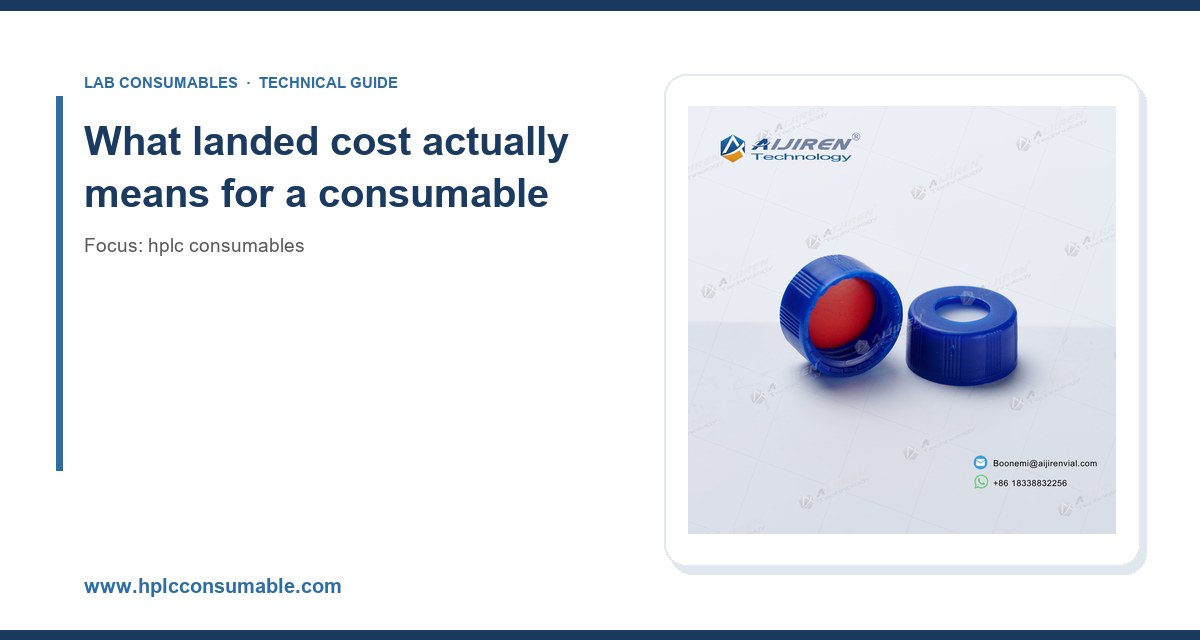
For closure selection specifically, the vial closures range matters because the cap is where the seal is made. A cap that is dimensionally correct but made from a resin with a different shrinkage rate will not hold torque the same way. If you are buying vials and caps from different suppliers, you own the fit problem. Buying them as a matched set from one source is a landed-cost decision, not a convenience.
A quick comparison: crimp vs screw vs snap
Here is the decision table I use. Numbers are for a 2 mL, 12 x 32 mm format on a typical autosampler.
- Crimp: lowest unit cost (often $0.15 to $0.25 per vial plus cap), best seal integrity for volatile samples, but needs a crimper ($400 to $900), a torque/height gauge, and operator technique. Rework rate if crimping is inconsistent: I have measured 3 to 8% of vials failing a leak check on a poorly maintained crimper.
- Screw: higher unit cost ($0.25 to $0.45), no tooling, resealable, torque band 0.8 to 1.2 N·m. Best for multi-injection and for labs without a crimper.
- Snap: fastest to close, lowest labour, but the seal is the weakest and not suitable for volatile analytes or long autosampler residence times. Use only where the method tolerates it.
The crimp option looks cheapest on the invoice and is often the most expensive once you count the crimper, the gauge, the training, and the rework. If your lab runs fewer than about 200 vials a week, the screw format usually wins on landed cost even at a higher unit price.
Column and filter costs: the part that dwarfs the vial
A vial costs cents. A column costs hundreds. A guard cartridge costs tens. The landed cost of a consumables programme is dominated by how long the column lasts, and column life is set by what you put on it. This is where procurement and analytical science have to talk to each other, because the cheapest filter is the one that lets particles through to the column.
Two numbers to hold in your head. First, the particle size of your stationary phase (commonly 1.8, 2.7, 3.5, or 5 µm) sets the frit porosity you need upstream; a 0.2 µm or 0.45 µm syringe filter is the usual choice for sample prep, and the wrong one either passes fines or adsorbs your analyte. Second, the guard column is a sacrificial part. A guard cartridge that costs $8 to $15 and extends analytical column life by 20% pays for itself many times over if the analytical column is $400 to $700. Skipping the guard to save $10 a week is the classic false economy.
I have watched a lab save $6,000 a year on filters and lose $18,000 in premature column replacements because the cheaper filter membrane shed fibres under high organic load. The membrane chemistry (nylon vs PTFE vs PVDF vs cellulose acetate) determines compatibility with your mobile phase, and incompatibility shows up as extractables, not as a visible failure. Ask for the extractables data. If the supplier cannot provide it, that is your answer.
For method context and the standards your consumables must support, the U.S. EPA SW-846 test methods are a useful reference point for regulated work, and vendor technical libraries such as Restek technical resources and the Agilent chromatography consumables pages give you the compatibility tables you need to specify filters and columns correctly. The Thermo Fisher chromatography and sample handling catalogue is another place to cross-check part numbers against instrument fit.
Building the landed-cost model: a worked example
Let me make this concrete. Suppose a lab runs 500 injections a week, 48 weeks a year, so 24,000 injections. It is choosing between two vial-and-cap options.
Option A (cheap): $0.18 per vial plus cap, loose tolerance, silicone/PTFE septum rated for 3 punctures. Measured failure rate: 4% of vials need re-injection, and one column is lost per quarter to particulate damage.
Option B (tight): $0.34 per vial plus cap, tight tolerance, pre-slit PTFE-faced septum rated for 10 punctures. Measured failure rate: 0.5% re-injection, no column losses in the last 12 months.
Annual vial cost: A = 24,000 x $0.18 = $4,320. B = 24,000 x $0.34 = $8,160. On the invoice, A wins by $3,840.
Now add the rest. Re-injections at A: 4% of 24,000 = 960 extra injections. At a fully loaded cost of $18 per injection (instrument time, solvent, scientist time, data review), that is $17,280. At B: 0.5% = 120 extra injections = $2,160. Column losses at A: 4 columns a year at $550 = $2,200. At B: zero.
Landed cost: A = $4,320 + $17,280 + $2,200 = $23,800. B = $8,160 + $2,160 = $10,320. Option B is $13,480 a year cheaper despite costing nearly twice as much per vial. The $18 per injection figure is the one to argue about in your own lab, because it varies, but the direction of the result does not change until the re-injection rate gap closes to well under 1%.
This is the calculation to put in front of the person who approves the purchase order. Unit price is a line item. Landed cost is a business case.
Supplier selection criteria with numbers
When I qualify a supplier for a consumables programme, I score them on the following. These are the criteria that separate a distributor from a supply partner.
- Lot traceability: can they give you the manufacture date, raw material batch, and CoA for the specific lot shipped? A yes here saves you inspection time and audit pain.
- Dimensional data: do they publish tolerance bands (for example ±0.2 mm neck OD) or just nominal dimensions? Nominal-only is a red flag.
- Extractables and leachables: for filters, septa, and tubing, do they have data on extractables in your mobile phase? For regulated work, this is non-negotiable.
- Inventory and lead time: what is the stated lead time on a routine item, and what is the fill rate over the last 12 months? Ask for the fill rate. A supplier who will not share it has a number you would not like.
- Change control: if they change resin, membrane, or mould, will they notify you before the change ships? A silent change is how a validated method breaks.
- Documentation: can they supply a certificate of conformance to a named standard, and do they reference the relevant ISO or USP chapter where applicable?
- Consolidation: how much of your routine list can they cover from one warehouse? Each additional supplier is another freight minimum and another receiving event.
Score each out of 5, weight them, and you will find the cheapest supplier is rarely the highest scorer. That is the point. The HPLC consumables catalogue is a starting point for part numbers and specifications, and the OEM vial range is where I point labs that need matched vial-and-cap sets without paying instrument-brand prices. Matched sets remove the fit problem from your risk register.
Operational precautions that protect the landed-cost number
You can buy well and still lose the saving in the lab. These are the controls I insist on.
- Torque control on screw caps: a calibrated torque driver set to 0.8 to 1.2 N·m. Hand-tight is not a specification. Recalibrate quarterly.
- Crimper maintenance: check the crimp height and seal with a gauge every shift. A worn crimper is the single biggest source of vial leak failures I have seen.
- Septum puncture budget: write the rated puncture count on the method sheet and enforce it. If the method needs six punctures, buy a septum rated for ten, not three.
- Filter compatibility check: confirm membrane chemistry against mobile phase before the lot goes into routine use. A 10 mL test injection is cheaper than a column.
- Storage discipline: keep septa and caps in sealed bags, away from solvent vapours, and rotate stock on a first-in-first-out basis. Volatile absorption is real and it shows up as ghost peaks.
- Lot quarantine: hold a new lot until the first system suitability run passes. Do not release a whole pallet on the strength of a CoA alone.
Troubleshooting checklist: when landed cost starts climbing
If your cost per accepted result is drifting up, work through this in order. I have used it to find the cause in under an hour more times than I can count.
- Rising re-injection rate? Check septum coring first. Look for a plug in the needle or a visible hole larger than the needle OD. Then check vial neck tolerance against the autosampler guide.
- Ghost peaks or carryover? Suspect septum extractables or a filter membrane incompatible with the mobile phase. Run a blank with a new lot.
- Short column life? Check the guard column change interval and the filter porosity. A 0.45 µm filter upstream of a 1.8 µm column is often too coarse for dirty matrices.
- Leaks at the cap? Check torque and crimp height. A 0.1 mm crimp height error is enough to fail a leak test.
- Missed picks or bent needles? Measure vial height and neck OD on a sample of 20 from the lot. If the spread exceeds the stated tolerance, reject the lot.
- System suitability failing on peak shape? Check for a partially blocked frit or a guard cartridge that is past its life. Both are consumable costs, not instrument faults.
- Unexplained OOS investigation? Pull the lot records for every consumable in the flow path and check for a supplier change notification you may have missed.
Each of these has a consumable cost attached. The point of the checklist is to attribute the cost to the right line so the next purchase decision is informed by data rather than by the invoice.
What I recommend
Build the landed-cost model before the next tender, not after. Use cost per accepted injection as the unit, and populate the model with your own re-injection rate and your own loaded cost per injection. For most labs I have worked with, the loaded cost lands between $12 and $25 per injection, and at those numbers the tight-tolerance, higher-puncture-count consumable wins on anything that is pierced more than twice.
Consolidate the routine list to one or two suppliers to cut freight minimums and receiving labour. Insist on published tolerance bands, manufacture dates, and extractables data. Buy vials and caps as a matched set. Enforce a torque band and a puncture budget in the method sheet. Quarantine new lots until system suitability passes. None of this is exotic. It is the difference between a purchase price and a cost.
The takeaway: a consumable’s unit price is the smallest part of what it costs you. If your procurement file compares vials on price per box, it is measuring the wrong number. Measure cost per validated result, put the failure modes in the model, and the cheap option stops looking cheap.
References & further reading
Related resources from our lab consumables network:
- Hplc Consumables at hplcconsumable.com
- Chromatography Supplier at chromatographysupplier.com
- Oem Vial at oemsamplevials.com
- Vial Closures at vialclosures.com
External references and standards: