
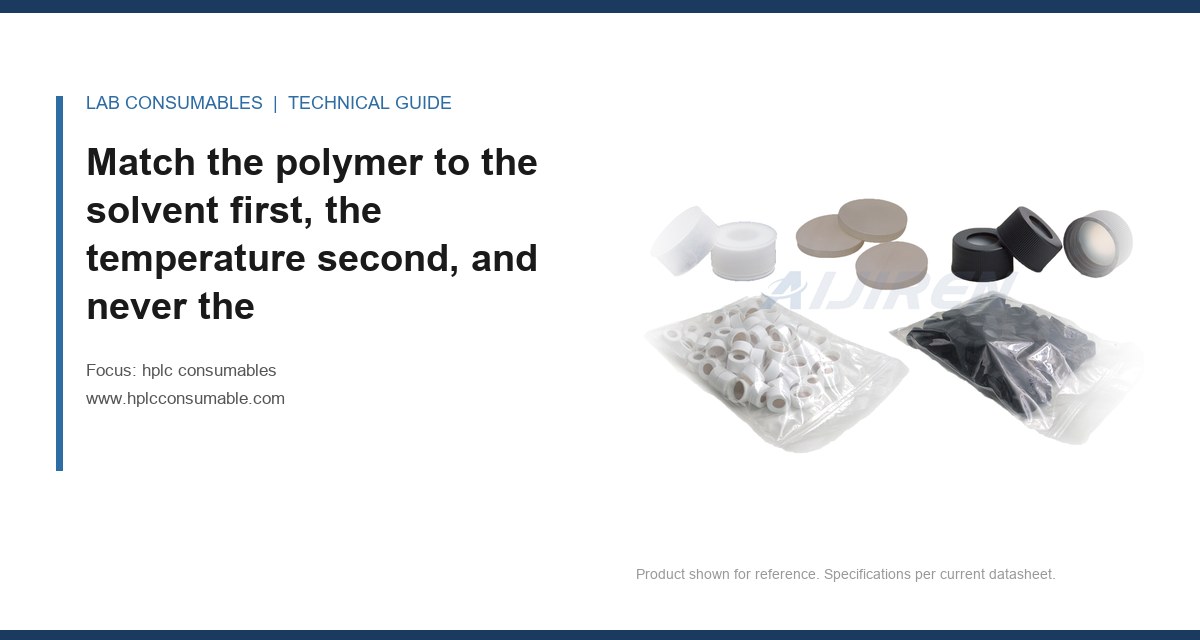
Last March a method transferring from acetonitrile to 100% methanol started losing peak area on the early-eluting acids, about 18% over a 40-injection sequence, and the autosampler was the last place anyone looked. The septa were the standard silicone/PTFE laminate, the ones we buy in bulk. Methanol at 40 °C pulled enough silicone extractable through the PTFE face that it collected at the injection port and the front of the column. Switching to a pure PTFE/silicone-free closure fixed it inside one sequence. That is the whole argument for this guide: choosing HPLC consumables materials is not a single decision, it is a decision per solvent, per pH, per temperature, and the wrong polymer fails in a way that looks like a chromatography problem rather than a materials problem.
Match the polymer to the solvent first, the temperature second, and never the other way round
Most labs pick a septum or a cap liner by what the catalog calls “general purpose” and then wonder why a method drifts after 200 injections. The order of decisions matters. Solvent compatibility is the gate. If the polymer swells or dissolves in your mobile phase, no temperature rating saves it. Temperature is the second gate because it accelerates everything: extraction, swelling, and creep. pH is the third, and it only applies to the wetted polymers that see aqueous mobile phases, which for most consumables means the liner and the frit, not the septum.
I run a simple screening rule that has survived a decade of method transfers. If the mobile phase is more than 60% acetonitrile or methanol, the septum must be PTFE-faced on the sample side with a silicone or EPDM backing that never contacts the liquid. If the mobile phase contains THF, DMSO, or dichloromethane, the septum must be all-PTFE or PTFE-faced with a fluorocarbon backing. If the method runs above 60 °C, silicone is out regardless of solvent. If the aqueous portion is buffered above pH 8 or below pH 3, EPDM liners are out and PTFE or a laminate with a PTFE sample face is in.
The four polymers you will actually meet
Four materials dominate the HPLC consumables world: PTFE, silicone, EPDM, and the PTFE/silicone or PTFE/EPDM laminate. Each has a distinct failure mode. Knowing the failure mode is more useful than knowing the datasheet number, because the datasheet number is measured on a virgin coupon and your septum is a punched, compressed, heat-cycled part.
| Material | Solvent resistance | pH window (aqueous contact) | Continuous temp | Typical failure when misapplied |
|---|---|---|---|---|
| PTFE (virgin) | Excellent against nearly all solvents; attacked by molten alkali metals and some fluorinating agents | 0 to 14 | 260 °C | Cold flow under compression; poor reseal after puncture, so it leaks on the second or third injection |
| Silicone | Poor against nonpolar solvents, toluene, hexane, DCM; swells 20 to 40% in some | 3 to 9 (short contact) | 200 °C | Extractable siloxanes eluting as ghost peaks; swelling that pushes the septum into the needle path |
| EPDM | Good against polar solvents and water; poor against aromatic and chlorinated solvents | 1 to 12 | 130 °C | Hardening and cracking after repeated autoclave or high-temperature cycles; compression set that loses seal at 50 injections |
| PTFE/silicone laminate | PTFE face handles solvent; silicone core provides reseal | 0 to 14 on the face | 200 °C | Edge wicking where the PTFE delaminates from the silicone, letting solvent reach the core |
The laminate is the workhorse of the industry and it is the right answer for most reversed-phase work below 60 °C. It is the wrong answer when the PTFE face is too thin, typically under 0.002 in, because a 22-gauge needle will punch through the PTFE and into the silicone on the first injection. A 0.005 in PTFE face on a 0.060 in silicone core reseals reliably for 50 to 100 punctures with a sharp needle. That is a materials spec, not a dimension spec, and it is the one you should ask for when you specify vial closures for a method that runs 96-well plates.
PTFE is chemically inert and mechanically the worst choice for a septum, which is why the laminate exists
Pure PTFE has the broadest solvent resistance of any polymer you can buy. It is also soft, cold-flows under compression, and does not spring back after a needle passes through it. A pure PTFE septum on a crimp cap will seal the first injection and leak by the third because the puncture does not close. The leak shows up as a low response on one well, then a sequence failure, then a call to the supplier about “bad septa.” The septa are fine. The material choice is wrong for a reseal application.
Where pure PTFE belongs is on the sample-facing surface of a laminate, or as a liner in a cap that is not punctured. If you are running headspace or a method that uses a septumless inlet, a PTFE-faced liner is the right call because it will not extract into the headspace. The lesson is that PTFE’s inertness is only useful when it is backed by an elastomer that provides the reseal. That is the entire design rationale for the laminate, and it is why I will not sign off on a pure PTFE septum for an autosampler method that runs more than 10 injections.
What “PTFE-faced” actually means on a datasheet
Suppliers say “PTFE-faced” and mean anything from a 0.001 in film to a 0.010 in sheet bonded to a 0.125 in silicone core. The face thickness controls puncture resistance; the core thickness controls reseal. Ask for both numbers. A face under 0.003 in will be breached by a 22-gauge needle at the 20th puncture on a well-used instrument. A core under 0.040 in will not provide enough compression to seal against a 0.5 mm orifice. The combination that has worked for us across Agilent and Thermo autosamplers is a 0.005 in PTFE face on a 0.060 in silicone core, which is roughly the construction behind most of the HPLC consumables we stock for 2 mL crimp and snap caps.
Silicone is the reseal champion and the extractable liability, and temperature decides which one you get
Silicone is the best resealing elastomer in common use. It also sheds low-molecular-weight siloxanes into any solvent that contacts it, and those siloxanes elute as a rising baseline or as discrete peaks at m/z 73, 147, 207, 281, and 341 in MS. The extraction rate goes up steeply with temperature. At 25 °C a silicone septum in contact with acetonitrile releases a barely detectable amount over 24 hours. At 60 °C the same septum releases enough to put a ghost peak at 2.3 minutes in a 5-minute run. I have watched a lab chase that peak through three columns before someone ran a blank with no injection and found the peak was still there.
The practical rule is that silicone is a room-temperature material for HPLC. Above 40 °C, use a PTFE-faced laminate so the silicone never touches the liquid, or move to an EPDM backing. Above 60 °C, silicone has no place in the flow path at all. The temperature rating on the datasheet (often 200 °C) is a thermal degradation number, not an extraction number, and confusing the two is the most common materials error I see in method transfer packages.
Field case: the ghost peak that was not a column problem
A contract lab running a 12-minute gradient on a C18 column saw a peak at 2.8 minutes appear after a method transfer from a 30 °C method to a 55 °C method. Retention time matched nothing in the standard mix. They replaced the column, then the guard, then the mobile phase. The peak persisted. I asked them to run a blank with the autosampler needle bypassed and the peak vanished. The septa were silicone/PTFE laminate with a 0.002 in PTFE face, and the face had been breached by the needle on the high-temperature method because the silicone softened and the needle punched deeper. The fix was a 0.005 in PTFE face and a 10 °C drop in the sample compartment temperature. The peak was gone in the next sequence.
EPDM wins the aqueous and buffer game and loses the solvent game
EPDM is the polymer I reach for when the method is aqueous, buffered, or runs a high-ionic-strength mobile phase. It handles pH 1 to 12 continuously, it resists polar solvents well, and it does not shed siloxanes. It is also the right choice for a cap liner in a method that contacts 0.1% formic acid or a phosphate buffer at pH 7.4, because silicone will slowly hydrolyze and PTFE is overkill if the liner is not punctured.
Where EPDM fails is in the presence of aromatic and chlorinated solvents. Toluene, xylene, dichloromethane, and chloroform will swell EPDM 30 to 50% and soften it. A swollen EPDM liner will extrude into the cap orifice and block the needle. I have seen a 96-well plate where 12 wells out of 96 failed to inject because the EPDM liners had swelled after a method change from methanol/water to methanol/DCM. The symptom was a “needle error” on the autosampler, not a chromatography problem, which is why the materials choice is a method-development decision, not a purchasing decision.
Temperature and EPDM compression set
EPDM has a continuous service temperature around 130 °C, but the number that matters for a septum is compression set. After 100 hours at 100 °C, a typical EPDM septum takes a set of 20 to 30%, meaning it no longer springs back to seal. If you are running a method at 80 °C or above, plan to replace EPDM closures every 500 injections, not every 2,000. The Restek technical resources library has compression-set data for their septa that is worth reading before you commit a high-temperature method to EPDM.
Laminate construction is where most method transfers go wrong
The laminate is a bonded structure, and the bond is the weak point. A PTFE/silicone laminate has a PTFE film bonded to a silicone core. If the bond is poor, solvent wicks in from the edge of the septum where the needle has cut it, and the silicone core swells. The swelling pushes the PTFE face up, the septum no longer sits flat in the cap, and the autosampler gripper either fails to pick the vial or the needle bends. The failure looks mechanical, but the cause is a materials bond.
Two things predict laminate failure. First, the edge seal: a good laminate has a continuous bond to the edge with no exposed core. Second, the solvent: acetonitrile and methanol are mild on the bond, but THF and DMSO will attack most adhesive layers within 24 hours. If your method uses THF, do not use a laminate. Use an all-PTFE septum and accept the reseal penalty, or move to a septumless inlet. The Agilent chromatography consumables and columns catalog lists the solvent compatibility for each septum construction, and it is the reference I use when a method transfer includes an unusual solvent.
Field case: the DMSO method that ate the laminate
A pharma lab transferred a DMSO-based solubility assay onto an HPLC with a standard PTFE/silicone laminate septum. By injection 30 the autosampler was reporting vial pickup errors on roughly 1 in 8 vials. The septa had swelled and domed, lifting the cap and jamming the gripper. The measurement that identified it was a simple caliper check: the septum thickness had gone from 0.065 in to 0.081 in after 24 hours of contact with DMSO. The fix was a move to an all-PTFE septum with a septumless inlet, which removed the reseal requirement entirely. The method ran clean for 2,000 injections.
pH windows are a wetted-surface question, and the septum is usually not the wetted surface
Most of the pH discussion in consumables catalogs is misdirected. The septum does not contact the mobile phase in a typical injection; the liner and the frit do. So the pH window that matters is the one for the liner and the frit, not the septum. PTFE liners handle pH 0 to 14. EPDM liners handle pH 1 to 12. Silicone liners handle pH 3 to 9 and should not be used with strong bases above pH 9 because the siloxane backbone hydrolyzes.
For frits, the material choice is usually stainless steel, PEEK, or PTFE. Stainless steel frits are fine above pH 2 and below pH 12; below pH 2 they corrode and shed iron into the mobile phase, which shows up as a rising baseline and a loss of peak shape for chelating analytes. PEEK frits handle pH 0 to 14 but are limited to about 100 °C and 4,000 psi. PTFE frits are the inert choice but have lower mechanical strength and will deform under high pressure. If your method runs a pH 1.0 mobile phase, the frit is the part to check, not the septum.
A pH and temperature decision table for the wetted parts
| Condition | Septum | Liner | Frit |
|---|---|---|---|
| pH 2 to 8, 25 to 40 °C, ACN or MeOH | PTFE/silicone laminate, 0.005 in face | PTFE or EPDM | Stainless steel |
| pH 1 to 2, 25 to 40 °C | PTFE/silicone laminate | PTFE | PEEK or PTFE |
| pH 9 to 12, 25 to 40 °C | PTFE/silicone laminate | PTFE or EPDM | PEEK |
| Any pH, 60 to 80 °C | PTFE-faced, EPDM backing | PTFE | PEEK or PTFE |
| THF, DCM, DMSO, any temperature | All-PTFE or septumless | PTFE | PTFE |
This table is the one I keep taped inside the method-transfer binder. It is not exhaustive, but it covers about 90% of the methods I have seen in the last five years, and it will keep you out of the failure modes that cost a sequence rather than a single injection.
What the standards actually require, and what they leave to you
USP 621 sets the performance bar for system suitability, not the material. It does not tell you which polymer to use. U.S. EPA SW-846 test methods specify a container and a holding time, not a septum material. This is deliberate: the standards assume the analyst knows the chemistry. The material choice is yours, and it is the one part of the method that is not audited until it fails. I have seen a 483 observation written against a lab that could not produce a material compatibility record for its septa. The fix was a one-page table like the one above, signed and dated, in the method file.
If you are buying against a validated method, the material spec belongs in the method file. If you are buying against a development method, the material spec belongs in the transfer protocol. Either way, the spec should name the polymer, the face thickness, the core thickness, and the temperature and pH window the part is qualified for. That is a materials spec, and it is the only thing that will survive an audit or a method transfer.
A troubleshooting checklist for when a material choice is already failing
When a method starts drifting, losing response, or showing ghost peaks, run this checklist before you change the column. In my experience, about 40% of these events trace to a consumable material, not the separation.
- Run a blank with the needle bypassed. If the ghost peak persists, the source is upstream of the needle, which means the mobile phase or the frit, not the septum.
- Run a blank with the needle in place but no injection. If a peak appears, the septum or the liner is the source.
- Measure the septum thickness before and after 24 hours of solvent contact. A change of more than 5% means swelling, and the material is wrong for the solvent.
- Check the puncture count. If the septum has more than 50 punctures with a 22-gauge needle and the response is dropping, the reseal has failed.
- Check the cap torque. A crimp cap should be sealed to 8 to 12 in-lb on a hand crimper; over-torque cold-flows a PTFE septum and under-torque lets the septum lift.
- Check the pH of the aqueous phase against the liner material. A pH 10 buffer against a silicone liner will hydrolyze the liner within a week.
- Check the method temperature against the septum rating. A 60 °C method against a silicone septum will extract siloxanes within one sequence.
If two or more of these checks come back positive, the material is the problem and no amount of column conditioning will fix it. The Thermo Fisher chromatography and sample handling documentation has a compatible materials matrix that is worth keeping next to the instrument, and the chromatography supplier network can usually confirm the face and core thickness of a given part number if the datasheet is vague.
Buying rule: specify the polymer by the failure you can tolerate, not the one you hope to avoid
The decision rule is simple. For reversed-phase methods below 40 °C with acetonitrile or methanol, buy a PTFE/silicone laminate with a 0.005 in PTFE face and a 0.060 in silicone core, and replace it every 100 punctures. For aqueous or buffered methods at pH 1 to 12, buy EPDM liners and PTFE-faced septa. For methods above 60 °C, or for THF, DCM, or DMSO, buy all-PTFE or move to a septumless inlet and stop pretending a laminate will hold. Anything else is a compromise you should document in the method file, because the day the method transfers to a different instrument or a different solvent, that compromise is what will fail first. The OEM vial and closure spec sheets from your supplier should carry the face thickness and the temperature window; if they do not, that is the first question to ask before the next order.
References & further reading
Related resources from our lab consumables network:
- Hplc Consumables at hplcconsumable.com
- Chromatography Supplier at chromatographysupplier.com
- Oem Vial at oemsamplevials.com
- Vial Closures at vialclosures.com
External references and standards: